Growing ownership and awareness
of biodiversity issues by private-sector players
The first IUCN African Protected Area Congress (APAC) was held in Kigali, Rwanda, from July 18 to 23. It brought together representatives of governments and public administrations, civil society, indigenous communities, the private sector and research institutions. In all, over 2,500 participants from 92 countries, including 52 African countries, were present in Kigali.
The project team was very active on this occasion. Four BIODEV2030 highlights punctuated the congress. Objectives: to promote mainstreaming of biodiversity, to highlight the project's specific scientific approach and multi-stakeholder dialogue, and to make the voice of the private sector heard.
Over fifty members of government, NGOs and the private sector attended the BIODEV2030 sessions. These sessions, designed to bring the perspectives of public and private stakeholders to the table, provided an opportunity to cross-reference national experiences.
The participation of CBD focal points from Gabon, Guinea, Madagascar andUganda testified to the commitment and dynamism of these countries with regard to BIODEV2030.
The presentations by the 3 sector representatives (notably from the agricultural sector) illustrated the growing appropriation of the BIODEV2030 project by the private sector. Benin 's former Minister for the Environment praised their awareness of the need to change practices.
Finally, the Congress was an opportunity for project managers from 9 African countries to present the BIODEV2030 project and its national implementation, and to consolidate our project community, notably by working on the lessons learned from BIODEV2030.
" We are all co-responsible for the degradation of biodiversity, and it is together that we will find the solution ".
Joseph KOUTCHIKA, Coordinator of the Benin Rice Growers Consultation Council

4 BIODEV2030 HIGHLIGHTS AT THE CONGRESS
The four sessions organized by BIODEV2030 were public and integrated into the APAC program. They provided an opportunity for representatives of the public authorities of the countries and private sectors involved in the project to present the BIODEV2030 approach applied to their countries, and to share their experiences. In addition to these four sessions, a capitalization workshop was held to draw lessons from past phases of the project.
Identifying the main threats to biodiversity in order to develop robust sectoral voluntary commitments: lessons from the BIODEV2030 project, based on a scientific approach

- M. SAMOURA (CDB-PFN Guinea)
- Mr. ONYAI (CBD-PFN Uganda)
- Mr MOUBA (CDB-PFN Gabon)
- M. OUSSOU (Director General of Agriculture, Gabon)
- Mr. MENGISTU (Executive Director, Ethiopian Chamber of Commerce and Sectoral Associations)
This session focused on the key role played by institutions in integrating biodiversity into economic activities, in particular the CBD's national focal points, looking back at the experience of Gabon, Uganda and Guinea. The round table also provided an opportunity to hear the motivations of two sector players in Ethiopia and Gabon for taking biodiversity into account in their activities.
BIODEV2030 Conservation Clinic APAC - Presentation
From OEWG4 (Nairobi) to COP15 (Montreal): lessons from the BIODEV2030 project and future challenges

- M. MOUBA (CDB-PFN Gabon)
- Ms. RANTO (CDB-PFN Madagascar)
- Mr. ONYAI (CDB-PFN Uganda)
- M. OUSSOU (Director General of Agriculture, Gabon)
- M. KOUTCHIKA (Coordinator of the Conseil de Concertation des Riziculteurs du Bénin)
- Mr MENGISTU (Executive Director of the Chamber of Commerce and Sector Associations)
The 16 pilot countries of the BIODEV2030 project developed a common vision on the integration of biodiversity, and on how this issue should be integrated into the future global agreement under discussion. This session was dedicated to testimonials from 4 BIODEV2030 countries (Ethiopia, Gabon, Benin and Madagascar) on the links between their BIODEV2030 experience and the future post-2020 global biodiversity framework.
Collaborative model tested as part of WWF's implementation of BIODEV2030: an experimental approach to reconciling economic development and biodiversity conservation

- M. OUEDRAOUGO (AT from Burkina-Faso)
- Ms NYARE (AT from Gabon)
This session was dedicated to the testimonies of two BIODEV2030 project managers, from Burkina-Faso and Gabon respectively: Mr. OUEDDRAOUGO and Ms. NYARE. They spoke about the success factors of the project and the pitfalls to avoid, while shedding light on the specificities of implementation in these two countries.
How to build ambitious, credible and action-oriented voluntary commitments? Lessons from 13 African countries involved in the BIODEV2030 initiative

- MR. ONYAI (CDB-PFN Uganda)
- Ms. RANTO (CDB-PFN Madagascar)
- M. KOUTCHIKA (Coordinator of the Conseil de Concertation des Riziculteurs du Bénin)
The conference provided an opportunity to present the central role played by CBD national focal points in mobilizing stakeholders in Benin, Madagascar and Uganda. The process of building sectoral voluntary commitments was also presented and discussed by the speakers.
BIODEV2030 APAC Workshop - Presentation
BIODEV2030 APAC workshop - Presentation by Mr Koutchika
OTHER ITEMS
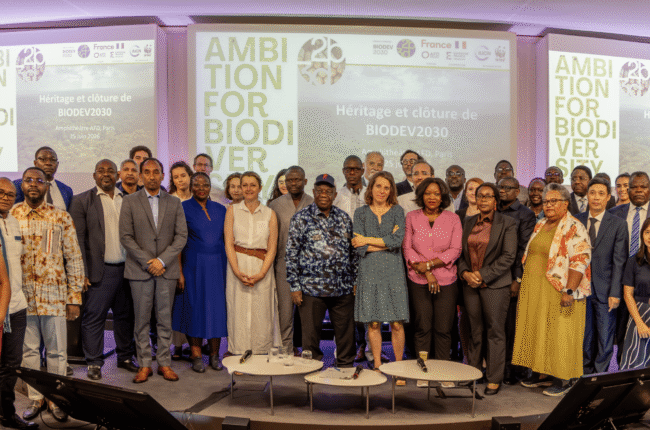
BIODEV2030 Comes to a Close: Six Years of Commitment to Placing Biodiversity at the Heart of Policies and Economic Sectors
On June 25, 2026, the BIODEV2030 partners met in Paris at the offices of the French Agency for […]
Read more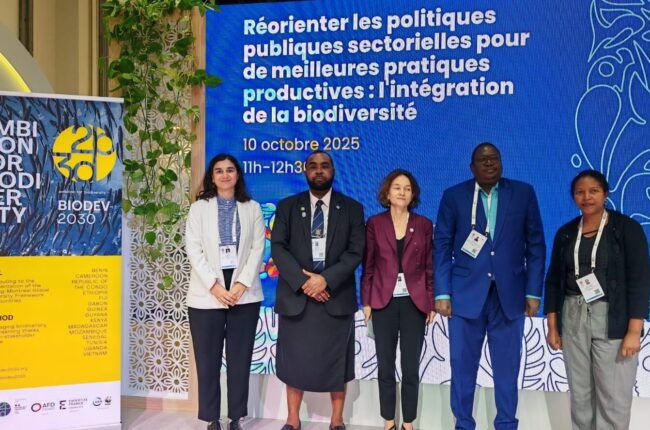
BIODEV2030 at the IUCN World Conservation Congress: an opportunity to promote project results
The World Conservation Congress, organized by the International Union for Conservation of Nature (IUCN), was held from 9 to [...].
Read more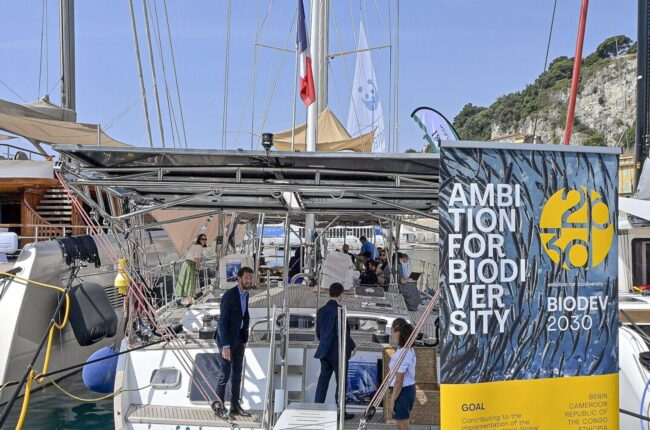
UNOC3: perspectives on better integration of marine biodiversity into public fisheries policies and production practices
France co-hosted the third United Nations Ocean Conference (UNOC-3) in Nice, France, from 9 to [...].
Read more
Identifying and discussing sectoral public policy instruments with a high impact on biodiversity
Encouraging changes in production practices at national level: BIODEV2030 supports countries in identifying the best policy instruments [...].
Read more