More than 40 people from 12 of the 16 BIODEV2030 pilot countries took part in the IUCN World Conservation Congress, held in Marseille from September 3 to 11, 2021. On this occasion, the project's stakeholders were able to share the initial national results, collectively develop courses of action for the coming phases and, finally, meet each other!
The project's progress and prospects were hailed at the highest political level, not only by the countries involved in the project, as witnessed by Burkina Faso's Minister of the Environment, but also by countries such as Mauritania and Niger, which have expressed their desire to join this dynamic. All underlined the importance and need for projects such as BIODEV2030 which, by developing a participatory and inclusive approach based on science, enables biodiversity and development to be reconciled.
After a year and a half of implementation strongly impacted by the health situation, BIODEV2030 stakeholders had the opportunity to meet physically and continue building the project's community, which until then had been essentially virtual. The five sessions organized by BIODEV2030 during the congress were designed to include all stakeholders in the dialogue, and to enable everyone to contribute their views on each stage of the program. The richness of the exchanges benefited country negotiators, private-sector players and the project team, who left with new energies and avenues for action for the upcoming commitment development phases.

5 BIODEV2030 highlights at the congress
Four of the five sessions organized by BIODEV2030 were open to the public and included in the congress program. They provided an opportunity for representatives of the public authorities of the countries and private sectors involved in the project to present the BIODEV2030 approach applied to their countries. In addition to these four sessions, a one-day workshop was held to consolidate the project's community, focusing on building the skills needed to engage stakeholders in the upcoming dialogue phases.
CALL FOR COMMITMENTS: MOBILIZING ECONOMIC SECTORS TO INTEGRATE BIODIVERSITY ACROSS THE BOARD
Based on the first stages of BIODEV2030 in the pilot countries (scientific diagnosis of threats and selection of priority economic sectors on the basis of their impact on biodiversity and their contribution to the country's development), this session illustrated the mobilization of private sector players. Their testimonials demonstrated their shared determination to move towards commitments whose effects are measurable at the level of the sectors involved. The 6 speeches demonstrated the avenues for concrete commitments in a variety of sectors, including fishing, mining, forestry and coastal zone management.
INTEGRATING BIODIVERSITY INTO DEVELOPMENT IS POSSIBLE: THE BIODEV2030 INITIATIVE IN AFRICA
This high-level political session - attended by the environment ministers of Burkina Faso, Mauritania and Niger, the deputy environment minister of Kenya and the deputy CEO of AFD - provided an opportunity to examine the political and technical challenges and opportunities of BIODEV2030 in Africa. Panelists from Mozambique, Tunisia and Senegal had the opportunity to present concrete commitments, while those fromUganda and Kenya reaffirmed their countries' political support for the project, which is at the heart of a set of strategic arrangements aimed at redefining the links between societies and natural resources for the Post2020 agenda.
RANKING THREATS TO BIODIVERSITY USING INNOVATIVE TOOLS (THE CASE OF FIJI, OCEANIA)
This virtual session focused on the implementation of BIODEV2030 in Fiji, and discussed the state of biodiversity and the main factors of erosion in the archipelago. Panelists presented the project's approach, an innovative tool not only for assessing threats to biodiversity, but also for sharing experiences and challenges in integrating its protection into the country's economic development strategies. The players testified to how BIODEV2030 is a powerful tool in support of Fiji's environmental laws.
SKILLS-BUILDING WORKSHOP TO ENGAGE STAKEHOLDERS
Throughout the day of September 08, 43 people involved in the BIODEV2030 project took part in a strategy game, the aim of which was to reflect on the effective integration of biodiversity conservation by the private sector. To achieve this, participants role-played the conditions of a strategic negotiation between government agencies, political decision-makers, companies, local communities, NGOs, donors and scientists around the mining and forestry sectors. The workshop was an excellent opportunity for skill-building and community-building, as government and private sector representatives, together with all the project's technical assistants, were confronted with the difficulties encountered in the pilot countries, and tried to collectively think of strategies to overcome the bottlenecks.
HIGH-LEVEL DIALOGUE: RECONCILING BIODIVERSITY AND DEVELOPMENT, ALL SECTORS OF SOCIETY GET INVOLVED!
This high point testified to the institutional commitments of the countries involved in the BIODEV2030 project, and their determination to see it live beyond its current temporal and geographical limits. Speakers unanimously agreed that integrating biodiversity into economic sectors is an essential priority, and that environmental protection must be seen as a lever for development. France reiterated its diplomatic ambition to make the protection of biodiversity one of the main pillars in achieving its development objectives. As the UEMOA representative emphasized, the demographic, economic, energy, climate, fiscal and democratic transitions underway in the world must spur us to act quickly, following the example of Madagascar, whose three identified sectors are ready to commit to reconciling biodiversity and development.
OTHER ITEMS
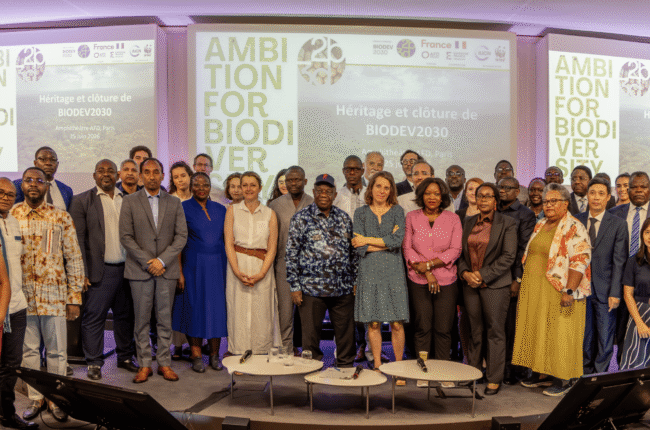
BIODEV2030 Comes to a Close: Six Years of Commitment to Placing Biodiversity at the Heart of Policies and Economic Sectors
On June 25, 2026, the BIODEV2030 partners met in Paris at the offices of the French Agency for […]
Read more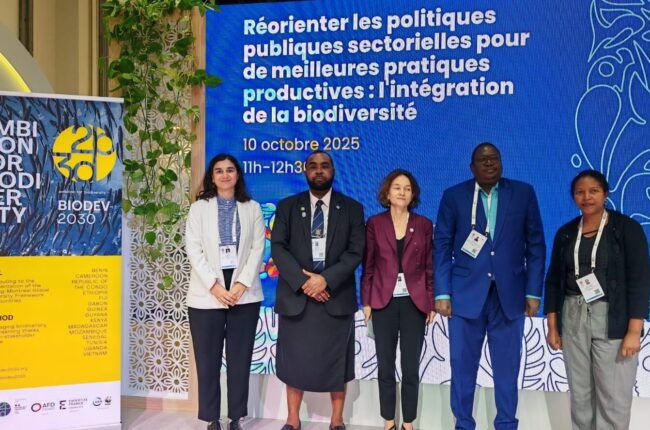
BIODEV2030 at the IUCN World Conservation Congress: an opportunity to promote project results
The World Conservation Congress, organized by the International Union for Conservation of Nature (IUCN), was held from 9 to [...].
Read more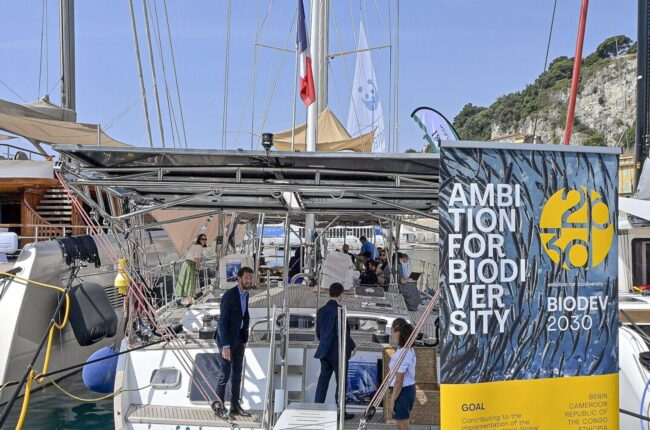
UNOC3: perspectives on better integration of marine biodiversity into public fisheries policies and production practices
France co-hosted the third United Nations Ocean Conference (UNOC-3) in Nice, France, from 9 to [...].
Read more
Identifying and discussing sectoral public policy instruments with a high impact on biodiversity
Encouraging changes in production practices at national level: BIODEV2030 supports countries in identifying the best policy instruments [...].
Read more