The Congo Basin Forest Partnership (CBFP), a central mechanism for preserving the region's forests and global biodiversity
Created in 2002, the CBFP brings together some 128 members, including 11 Central African countries, grouped into 7 colleges committed to the forest ecosystems of the Congo Basin. Members include nearly a hundred partners concerned by the Congo Basin forest ecosystems: ECCAS (Economic Community of Central African States), COMIFAC (Central African Forest Commission), financial partners including Agence Française de Développement, Congo Basin civil society, international NGOs, multilateral organizations, research and training institutions, and private sector operators.
The CBFP also works closely with COMIFAC, the regional body responsible for guiding and harmonizing forest and environmental policies, in the interest of promoting the conservation and sustainable management of forest ecosystems in the Congo Basin. Each year, members of the partnership gather to coordinate their priority activities, propose actions on emerging issues and share information with partners and networks active in the region.
The 20th Meeting of the Parties, held from June 3 to 6, 2024, took place in Kinshasa, capital of the Democratic Republic of Congo, under Franco-Gabonese co-facilitation.

PFBC opening ceremony, 03/06/2024 in Kinshasa, DRC
The CBFP has a number of priority objectives:
- Addressing the drivers of deforestation, reducing pressure on primary or naturally regenerated forests
- Protect biodiversity and wildlife by strengthening the conservation, security and development nexus, including transhumance.
- Promoting good forest governance, sustainable use of resources and land
- Combating climate change and its effects
- Improve living conditions for local and indigenous populations, including respect for human rights
These objectives are set out in a number of highlights at the Meeting of the Parties, which is structured around political segments, thematic workshops and side-events.
In line with these priorities and the objectives of BIODEV2030, the Expertise France team took part in a dedicated side-event to promote the project's lessons and disseminate its method.
WWF and IUCN, partners of Expertise France in the implementation of BIODEV2030 and active members of the civil society college, were also mobilized during the event, with several side-events organized, including the BIODEV2030 side-event.
This year, the CBFP brought together 9 ministers from the Congo Basin, and over 600 representatives from civil society, government, the private sector and local communities, under Franco-Gabonese co-facilitation.
Following the thematic workshops, recommendations were formulated by the spokespersons at the closing plenary session. The joint Franco-Gabonese declaration of MOP 20, "From Kinshasa to Belém: the Congo Basin Forest Partnership mobilizes for the forests of Central Africa" was also read out. These documents are available on the CBFP website. They contain key points on mobilizing the necessary funding and engaging the private sector.
" BIODEV2030: a dialogue method for the sectoral integration of biodiversity ".
Organized during World Environment Day, the project partners WWF-France, IUCN and Expertise France took the floor to share the lessons learned from Phase I and recall the ambitions of Phase II:
- identifying sectoral public policy measures to encourage changes in production practices.
- translating the commitments made in Phase I into action in pilot areas.
In the Congo Basin, BIODEV2030 aims to contribute to the implementation of the Kunming-Montreal agreement in 3 countries: Cameroon, Gabon and the Republic of Congo, by promoting the adoption of production practices that reconcile biodiversity and development. BIODEV2030 thus contributes to theCBFP's priority axis no. 2, "Consolidating land-use planning and sustainable value chains".
For Phase II, the project will identify sectoral public policy measures to support changes in production practices, and translate the commitments made in Phase I into action in pilot areas.
As Dr. Aurélie Flore Koumba Pambo, Gabon's UN Ambassador for Climate, Environment and Sustainable Development, and CBFP co-facilitator for Gabon, pointed out, "the recommendations formulated in the pilot countries will contribute to the implementation of the Kunming-Montreal Global Framework and the National Biodiversity Strategies and Action Plans (NBSAPs)". She spoke of the crucial work of BIODEV2030 and the need to continue efforts in the Congo Basin countries.

Mr Koumba Pambo speaking at the BIODEV2030 side-event
Mr. Jean-François Allogho, Director General of Protected Areas, Biodiversity and Prevention of Human-Wildlife Conflicts in Gabon, spoke about the context of the BIODEV2030 method and explained the economic sectors selected in Gabon. He also stressed the need for collaboration between ministries in order to achieve the voluntary commitments.
The event closed with a speech by Mr . Prosper Dodiko, President of the COMIFAC Council of Ministers, and Burundi's Minister of the Environment, who emphasized the dual need to feed people and preserve the environment, "two realities that are difficult to balance". This is what BIODEV2030 is aiming for, through its approach based on changes in production practices that can be reconciled with economic development.

Mr Prosper Dodiko speaking at the BIODEV2030 side-event, Kinshasa
This event opened up prospects for the launch of the project in the three Congo Basin countries involved in BIODEV2030 (Cameroon, Gabon, Republic of Congo), and reiterated France's determination, through AFD's commitments, to increase its ambition in terms of biodiversity mainstreaming and, in particular, support for biodiversity-related public policies.
For more information, see the official CBFP communication.
OTHER ITEMS
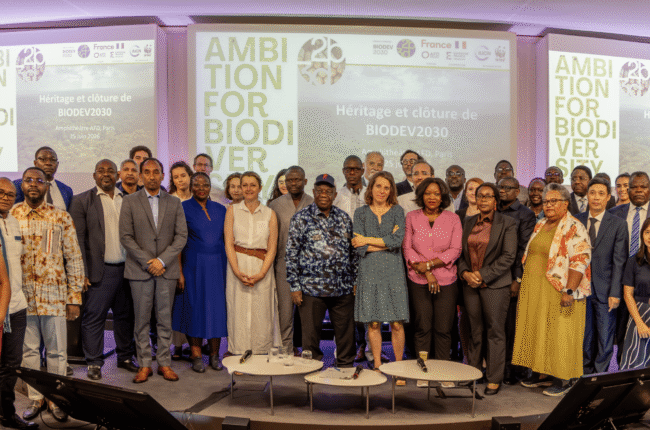
BIODEV2030 Comes to a Close: Six Years of Commitment to Placing Biodiversity at the Heart of Policies and Economic Sectors
On June 25, 2026, the BIODEV2030 partners met in Paris at the offices of the French Agency for […]
Read more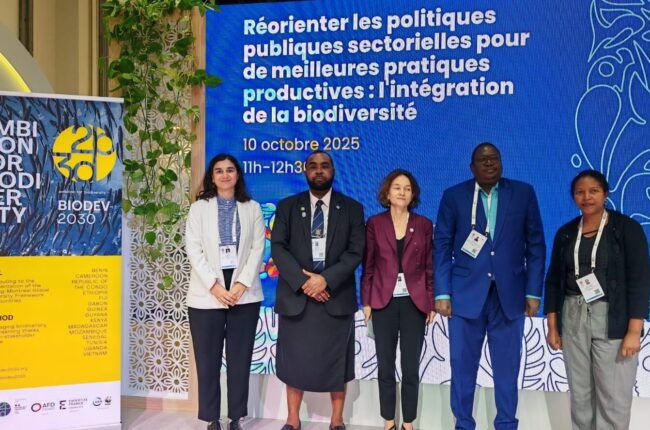
BIODEV2030 at the IUCN World Conservation Congress: an opportunity to promote project results
The World Conservation Congress, organized by the International Union for Conservation of Nature (IUCN), was held from 9 to [...].
Read more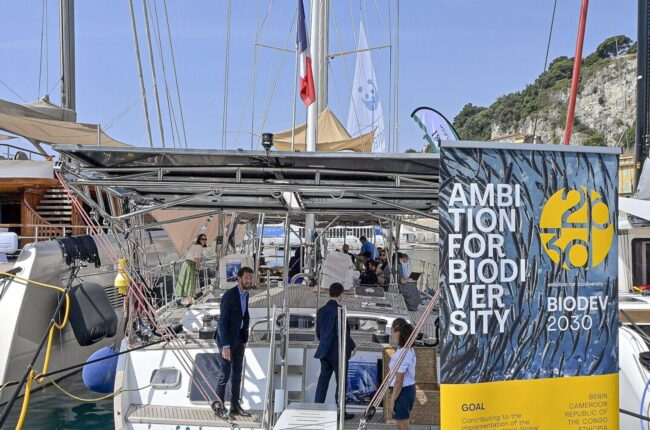
UNOC3: perspectives on better integration of marine biodiversity into public fisheries policies and production practices
France co-hosted the third United Nations Ocean Conference (UNOC-3) in Nice, France, from 9 to [...].
Read more
Identifying and discussing sectoral public policy instruments with a high impact on biodiversity
Encouraging changes in production practices at national level: BIODEV2030 supports countries in identifying the best policy instruments [...].
Read more