The sixteenth Conference of the Parties (COP16) to the Convention on Biological Diversity (CBD ) was held in Cali, Colombia, from October 21st to November 1st 2024. Chaired by Colombia under the aegis of its Minister of the Environment, Ms. Susana Muhamad, it was the first COP organized since the signing of the Kunming-Montreal Global Biodiversity Framework (KMGBF) at COP15, and the largest biodiversity COP ever organized, with over 20,000 people accredited (according to Le Monde). The global issues discussed focused mainly on :
- Financing biodiversity
- Updating and assessing the level of ambition of National Biodiversity Strategiesand Action Plans (NBSAPs).
- The implementation and accountability mechanism
- Sharing the benefits of Digital Sequence Information ( DSI)
Colombia also brought 5 specific themes to its presidency:
- Environmental crime, highlighting the links between deforestation and illegal mining
- The inclusion of indigenous peoples, particularly people of African descent, and local communities, and their key role in the protection and sustainable use of biodiversity
- A focus on "peace with nature", highlighted in the COP16 slogan
- The links between nature and climate
- Broad-based, long-term financing in conjunction with the renegotiation of developing countries' debt.
In addition to the 12 days of negotiations between 170 delegations (source: UN info), the entire BIODEV2030 team took the opportunity to promote the objectives of Phase II to delegations from the 15 project countries, and to strengthen its capacity to facilitate multi-stakeholder dialogue, at the heart of the BIODEV2030 method.
This international gathering of biodiversity stakeholders was also an opportunity for coordinators from the 15 countries involved in the project to share their experiences and best practices, and to work on the challenges ahead, while crossing perspectives with other international initiatives highlighted in particular by partners IUCN and WWF.
COP16 concluded with a dedicated side-event on the European Union Pavilion, focusing on mobilizing resources to change production practices.

Rendez-vous with Nature : mobilizing National Focal Points around the objectives of BIODEV2030 Phase II and enabling experience sharing on the sidelines of the negotiations.
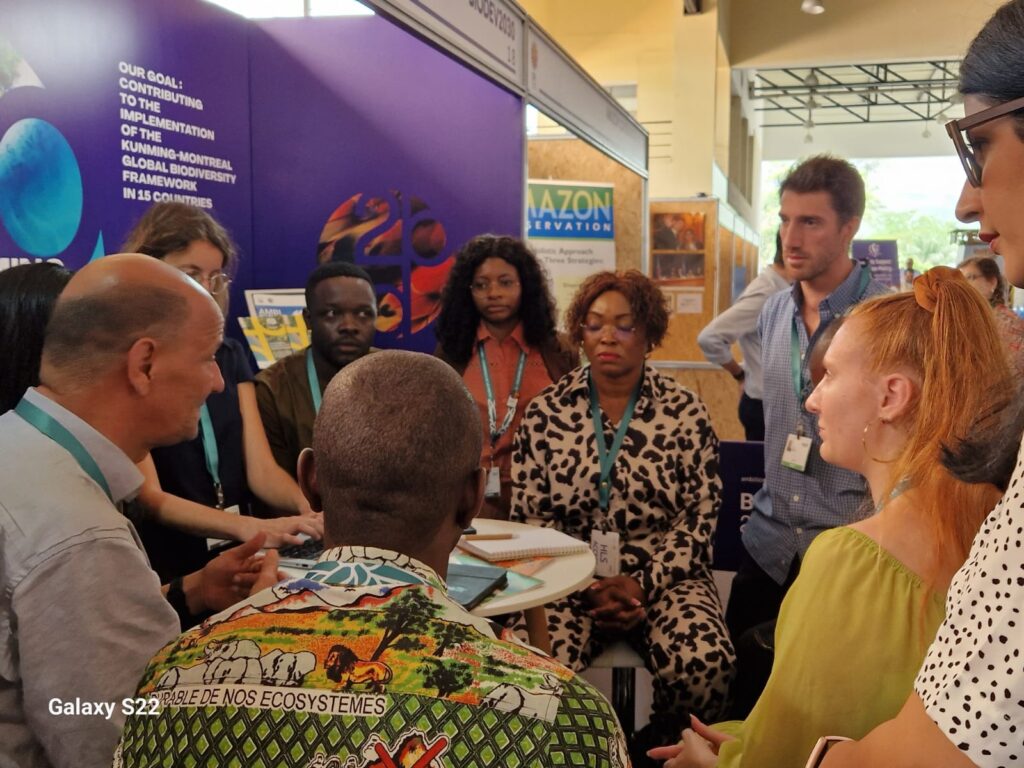
Through a series of Rendez-vous with Nature" high-level meetings held daily at the BIODEV2030 project stand, the team was able to raise awareness of the challenges of Phase II among CBD National Focal Points (NFPs) and representatives of numerous ministries, and to strengthen the links of IUCN and WWF national coordinators with their national governments. The team met Focal Points and representatives of delegations from 10 BIODEV2030 countries: Benin, Cameroon, Congo, Ethiopia, Gabon, Guyana, Kenya, Senegal, Tunisia and Uganda. Bringing together project coordinators and relevant administrations (Ministries of the Environment, Economy, or sectoral ministries), these Rendezvous were an opportunity to discuss the main challenges for biodiversity in these countries, and to identify how BIODEV2030 Phase II can be most useful for implementing the KMGBF, according to national contexts. The exchanges also provided valuable elements for identifying the strategic actions to be deployed to revise and/or implement the new NBSAPs, by enabling BIODEV2030 country coordinators to raise awareness among NFPs and their delegations of the sectoral integration of biodiversity and present them with upcoming activities at national and territorial levels.
Among the issues addressed, the following topics received particular attention:
- Identification of the territories where pilot projects will be developed, with the aim of organizing a second national dialogue workshop before the end of 2025 to confirm the targeted territory and sector(s) with all stakeholders (representatives of the relevant ministries and private sector, civil society, etc.);
- The main sectoral public policy instruments to be reformed or created to strengthen the alignment of national legislative and regulatory frameworks with the KMGBF, and the contribution of the dialogue initiated by BIODEV2030 on this subject;
- The mobilization strategies of the key sector ministries identified in Phase I, and the levers for action to reinforce synergies with existing programsin tense economic contexts;
- Maintaining long-term dialogue with the private sectorand the need to perpetuate the bodies initiated by BIODEV2030;
- The main challenges for biodiversity and economic developmentThe main challenges facing biodiversity and economic development are to identify the main threats to biodiversity, and the solutions available to promote more sustainable production practices in sectors that threaten biodiversity (fuelwood, mining, food and cash crops, market gardening, fish farming, fishing, etc.).
Rendez-vous with Nature also facilitated the sharing of experience and best practices, with cross-fertilization between several countries.
Tunisia and Cameroon, for example, discussed decentralized biodiversity management mechanisms within regional committees, and stressed the need to establish BIODEV2030 bodies at supranational level. Kenya andUganda discussed the project's contribution to the development of their national biodiversity strategy targets. Together withEthiopia, these 2 countries decided to focus the pilot project on thesustainable exploitation of firewood.
For all BIODEV2030 countries, the results of the study commissioned from ALTAÏ on the sectoral public policy instruments to be implemented at national level will soon be shared. These, based on the in-depth scientific diagnoses of phase I, will provide a solid basis for progress in identifying the relevant reforms to be carried out to reduce pressures on biodiversity. Depending on the context of each country, phase II of BIODEV2030 could thus contribute to achieving targets 10, 14, 15, 18 and 19 of the KMGBF, in complementarity withother structuring actions such as the Early Action Support program of the Global Environment Facility (GEF). In particular, this program provides technical and financial resources for governments to assess and align their regulatory frameworks, monitoring and evaluation systems and financial tools to achieve the KMGBF targets.

COP16, a key moment to bring the field team together and take capacity-building a step further
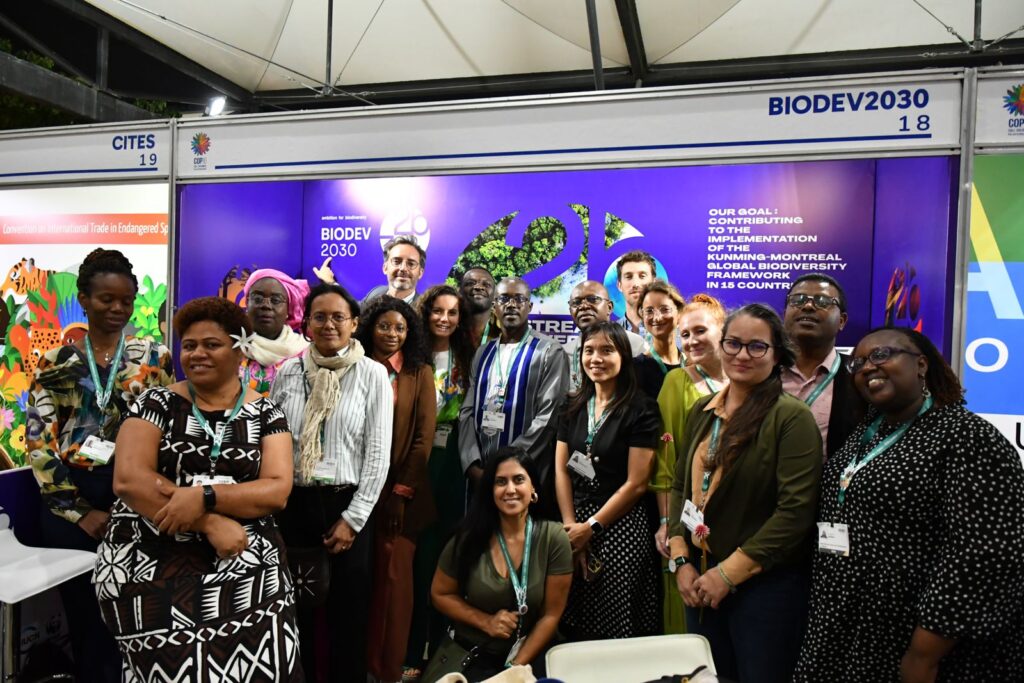
As a multi-country project, BIODEV2030 rarely has the opportunity to assemble its entire team in person. Taking advantage of the international event and the arrival of numerous delegations, the BIODEV2030 team, made up of the 2 global coordinators WWF and IUCN, the national coordinators of the 15 countries, and the Expertise France project team, met in Cali for a week. These precious moments provided an opportunity to deepen the capacity-building activities coordinated by Expertise France, with the support of the consultancy firm KINOME, which accompanies the project on the theme of facilitating multi-stakeholder dialogue.
A three-day training course was therefore organized, following on from an initial series of webinars held in the summer of 2024, the aim of which was to present various dialogue facilitation techniques, as well as the notions of know-how and savoir-être linked to achieving an informed consensus. These skills are indeed key to successfully discussing complex environmental issues, linked to major socio-economic implications, and leading at the end of Phase II to scenarios for public policy reforms that can be taken to a high level.
The face-to-face training enabled country coordinators to learn together and share their experiences and challenges in organizing national dialogue workshops, based on concrete case studies and examples from the field. Structured around several plenary sessions and participative workshops such as the World Café and real-life situations, the training helped coordinators to anticipate the tensions that will arise during national dialogue workshops, using recognized methods of conflict management, prioritization of issues and experience sharing.
The training focused in particular on :
- the facilitator's posture and the keys to ethical leadership to boost communication potential ;
- collective intelligence tools to moderate and guide dialogue within the framework of sectoral public policy reforms reconciling biodiversity and economic development;
- diagnostic tools to prepare for dialogue, such as stakeholder mapping, the PARDI tool (Problem, Actors, Resources, Dynamics, Interactions) and the systems approach to guide changes in production practices.
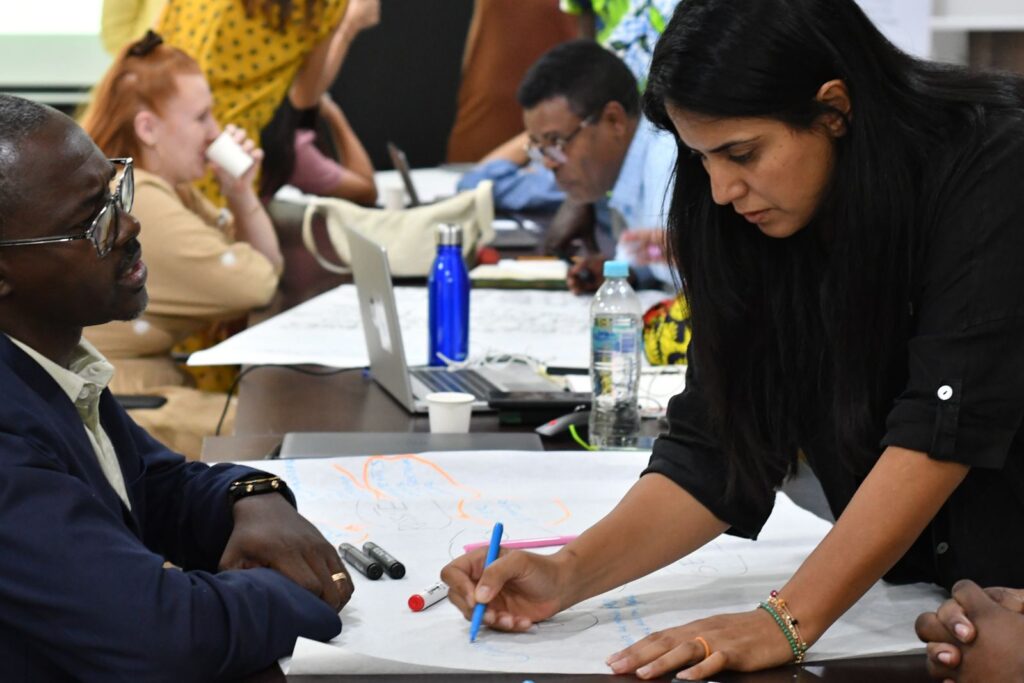
These modules were complemented by a session of the serious game Planet C-Play Again? hosted by LEAF Inspiring Change and KINOME, which takes place half online and half on a board.
This game mobilizescollective intelligence for the ecological transition, around a concrete issue combining sustainable management of natural resources, human development and conservation. In the form of an interactive workshop and under conditions that come close to the real world, participants learn to work together to develop scenarios for solutions that are beneficial to all. Applied to BIODEV2030 issues, the serious game highlights the benefits of dialogue and negotiation for the sustainable management of natural resources, and for reaching compromises. Planet C also mobilizes science by inviting participants to adapt to little-known variables in a limited timeframe, and to measure the impact of their decisions.
This type of game has already been used as part of BIODEV2030, notably to facilitate multi-stakeholder dialogue workshops at territorial level, in the Thiès region of Senegal. While Senegal is expected to extend this working method during Phase II, other countries have recently expressed interest in organizing a similar serious game to prepare dialogue workshops, by bringing strategic players in their country to the table.
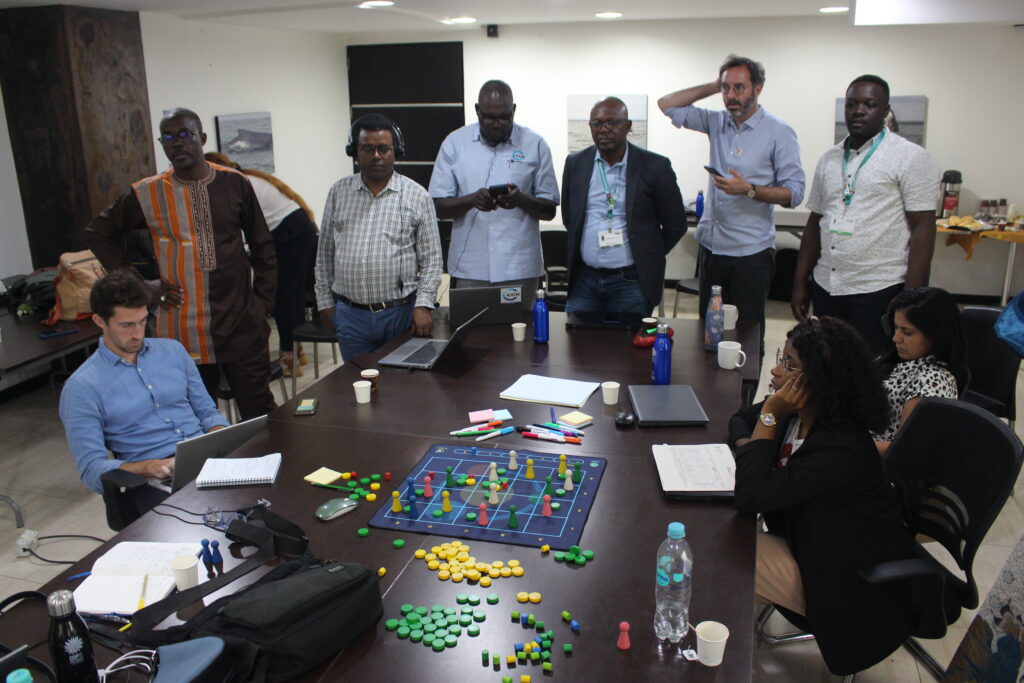
Organization of the serious game Planet C-Play Again by KINOME and LEAF Inspiring Change
COP16 draws to a close: towards mobilizing resources to finance biodiversity, a challenge shared by developing countries
While negotiations on mobilizing financing for biodiversity were in full swing, BIODEV2030 brought COP16 to a close with its side-event on Friday November 1, entitled: "How can BIODEV2030 mobilize resources in developing countries, by supporting key public policy changes? This is a topic in line with the current issues being discussed by negotiators, and central to Phase II of the project. This phase aims to :
- Identify sectoral public policy instruments to reduce pressures on biodiversity
- Enable local players to co-construct pilot projects designed to reduce pressure on biodiversity, and bring them to the attention of financial players (multilateral/bilateral development banks or private players) interested in supporting changes in production practices.
To discuss this issue, which is at the heart of COP16, the panel brought together several experts:
- Mr Ali Ben Temessek, CBD National Focal Point for Tunisia
- Camille Hosteint, BIODEV2030 coordinator for WWF
- Ms Caroline Aguti, Head of Health, Safety and Environment, Ministry of Energy and Mineral Development, Uganda
- Frédéric Castell, Senior Biodiversity Mainstreaming Expert, Food and Agriculture Organization (FAO)
- Ms. Ximena Guzman, Environment & Rural Development Officer, AFD Colombia agency

As Ximena Guzman from AFD's Colombian office pointed out, "BIODEV2030 reflects France's ambition to increase investment in biodiversity to 1 billion euros". The initial investment in the project should generate a leverage effect, enabling pilot projects and key reforms identified to find their way to donors. BIODEV2030 countries will now need to identify their country's biodiversity financing strategies, and the relevant financial tools for the selected sectors and territories.
To illustrate the types of public policy that could be financed, Camille Hosteint of WWF presented the initial results of the ALTAÏ study, using the example ofshrimp fishing in Madagascar, and the different categories of instruments identified (sectoral, commercial and fiscal) according to their relative levels of sensitivity to biodiversity. The solutions promoted by the study include the reform of existing instruments, their implementation and monitoring, or the introduction of new instruments. These scenarios will be adapted by stakeholders at forthcoming national dialogue workshops, necessarily involving the sectoral ministries concerned.
As a mirror image, Caroline Aguti, from the Ministry of Energy and Mineral Development, spoke about the dynamics and challenges inherent in Uganda's fuelwood sector, on which BIODEV2030 phase II will focus, and the conservation targets introduced in the national energy and biomass strategies. She recalled the need to involve the private sector and financial players in the dissemination of new, more sustainable practices and technologies enabling the exploitation of alternative energy sources.
The side-event provided an opportunity to cross-reference perspectives with the pilot project developed by the FAO since 2021 onintegrating biodiversity into the agricultural sector. Frédéric Castell, FAO expert, presented the activities deployed to implement KMGBF target 10, on the sustainability of production systems, and the synergies with BIODEV2030: support to countries on NBSAPs and sectoral integration of biodiversity through sustainable agricultural policies and practices. Among the priority needs identified for Madagascar and Uganda are investment in the transformation of agri-food systems, the introduction of tax incentives, and the sharing of best practices.
As a pioneer in biodiversity mainstreaming, BIODEV2030 was able to share its main results and disseminate its method, while linking up with several other initiatives with a similar geographical scope. Extending its ambitions to at least 2026, BIODEV2030 will once again be present at major international biodiversity events, such as theUNOC (United Nations Ocean Conference) and the IUCN World Conservation Congress in 2025.
In the meantime, project activities are continuing, with the organization of the 2nd national and, in some countries, territorial dialogue workshops, and the continuation of training activities provided by Expertise France, notably on resource mobilization, in conjunction with several donors.
OTHER ITEMS
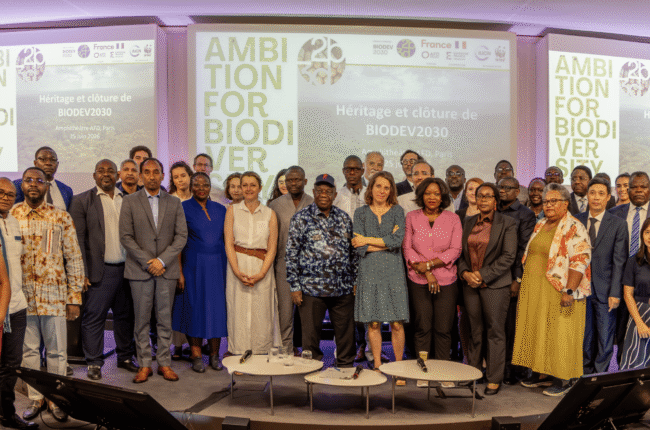
BIODEV2030 Comes to a Close: Six Years of Commitment to Placing Biodiversity at the Heart of Policies and Economic Sectors
On June 25, 2026, the BIODEV2030 partners met in Paris at the offices of the French Agency for […]
Read more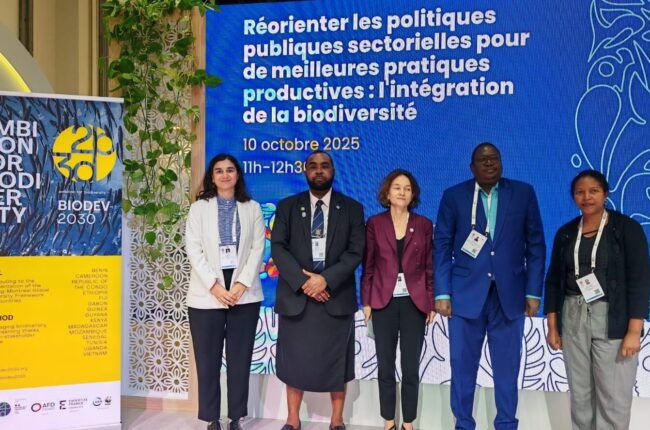
BIODEV2030 at the IUCN World Conservation Congress: an opportunity to promote project results
The World Conservation Congress, organized by the International Union for Conservation of Nature (IUCN), was held from 9 to [...].
Read more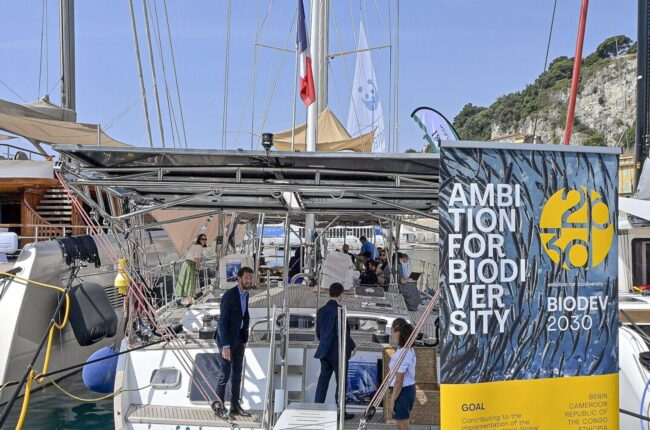
UNOC3: perspectives on better integration of marine biodiversity into public fisheries policies and production practices
France co-hosted the third United Nations Ocean Conference (UNOC-3) in Nice, France, from 9 to [...].
Read more
Identifying and discussing sectoral public policy instruments with a high impact on biodiversity
Encouraging changes in production practices at national level: BIODEV2030 supports countries in identifying the best policy instruments [...].
Read more