France co-hosted the third United Nations Ocean Conference(UNOC-3) in Nice, France, from June 9 to 13, 2025. The main objective of this meeting was to promote the commitment of countries and stakeholders to the implementation of MDG 14 on the conservation and sustainable use of oceans, seas and marine resources, as well as to accelerate the ratification of the International Treaty for the Protection of the High Seas and Marine Biodiversity (BBNJ) in order to reach the threshold of 60 States necessary for its entry into force. While a number of announcements were made to strengthen ocean protection, such as the creation by French Polynesia of the world's largest marine protected area, UNOC3 also saw the signing of numerous international cooperation programs, including the Great Ocean project in the Guiana Shield, with which BIODEV2030 is collaborating.
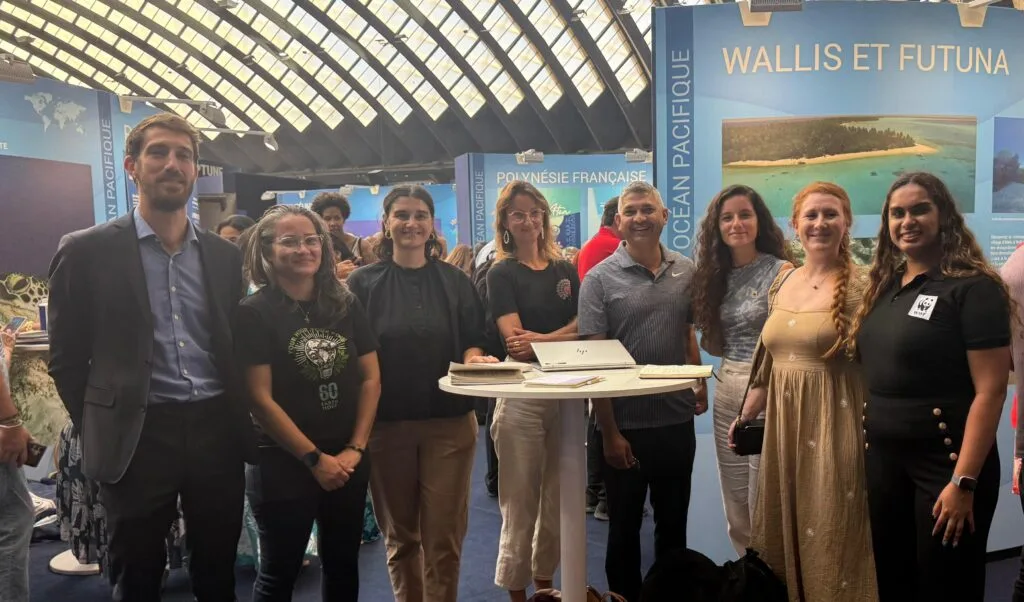
The BIODEV2030 project was present throughout the week, and took advantage of the event to highlight its key activities in the 6 project countries working on the "Oceans" theme(Fiji, Mozambique, Senegal, Guyana, Madagascar, Vietnam).
By highlighting the project's successes in these countries, BIODEV2030 is pursuing the dual aim of promoting its biodiversitymainstreaming method, applied in particular to the fisheries sector, to the parties present at UNOC3, and of raising awareness among donors and international organizations of the results and prospects arising from Phase II of the project. The project also strengthened the presence of three national delegations (Madagascar, Mozambique, Suriname).
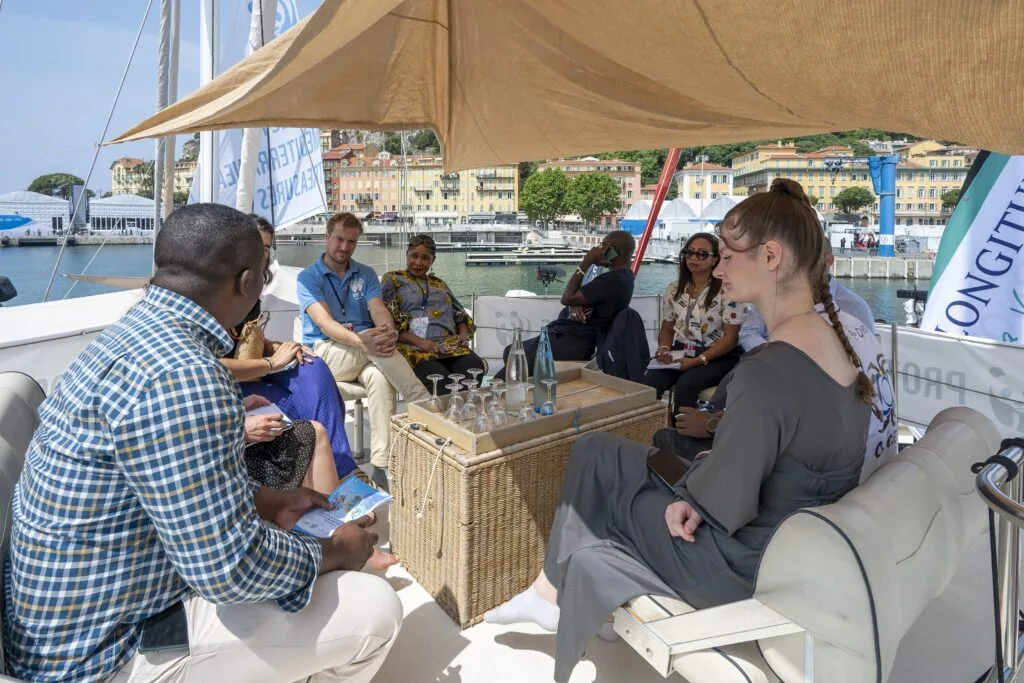
BIODEV2030's presence at UNOC3 was illustrated by two highlights: the organization of a side-event on the joint Pavilion of the French Biodiversity Office, UNESCO Ocean, and the Italian Institute of Marine Sciences, Beyond Bordersand a joint event with the NoCaMo(Nothern Canal Mozambique) project project, on the Blue Panda sailing boat.
Common threats to biodiversity from IUU fishing practices
The first event on the Beyond Borders Pavilion featured a dialogue between three representatives of the Fisheries Ministries of Madagascar, Mozambique and Suriname, who outlined the main threats to marine biodiversity in their countries, the action plans implemented by their institutions, and the challenges encountered in these activities. They highlighted the sectoral public policy instruments prioritized to combat illegal, unreported and unregulated (IUU) fishing, strengthen fish stock monitoring capacities, or improve fishing practices in the artisanal sector. They also presented how their governments are working with civil society and the private sector to develop concerted management plans for natural resources, enabling economic development imperatives to be taken into account in poverty-stricken contexts.
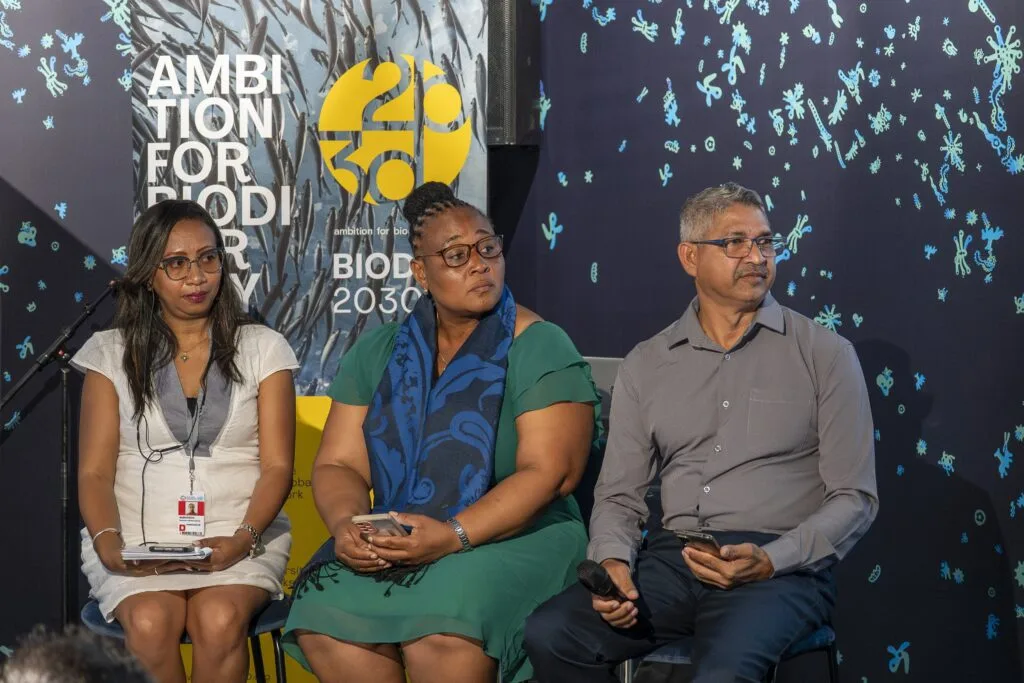
Among the main common threats to biodiversity, these countries reported significant IUU fishing, particularly by artisanal fleets, leading to overexploitation of resources and high levels of by-catch, or juvenile fish, which could be avoided by using alternative, more selective gear. The use of unregulated gear contributing to habitat degradation, such as beach seines, is a challenge shared by the shrimp fishing industry. Several states have mentioned pressure on certain target species, even to the point of resource depletion (in the Guyana Plateau region in particular), as well as on protected species.
Despite existing regulatory frameworks to regulate fishing practices and take better account of biodiversity, BIODEV2030 countries face challenges in their implementation, due to a lack of capacity on the part of governmental organizations and a deficit in fisheries monitoring by the actors in charge of monitoring. Non-compliance with licensing systems and regulated zones by so-called "ghost" or illegal fleets has resulted in a significant gap in production practices between the industrial and artisanal sectors. Difficulties in enforcing standards in artisanal fishing are compounded by the limited ability of state actors to raise awareness of good practices among fishermen, and to promote the associated long-term benefits, such as resource regeneration and higher-quality catches.
For 14 of the 15 BIODEV2030 countries, summary sheets on these main threats have been produced with Altai Consulting and are available on the website (see here). They list existing pressures by sector, associating them with distinct production practices, based on the DPSIR(Driver, Pressure, State, Impact, Response) methodology.
Improving stock monitoring for better resource management: the need for a regional approach
As part of the BIODEV2030 project, Madagascar, Mozambique and Suriname have all chosen to focus multi-stakeholder dialogue on potential reforms to be implemented in the fisheries sector, involving private players, civil society and the government. The representatives of the sectoral ministries present recalled the role of their institutions in the development of sustainable management plans for fisheries resources, favoring an ecosystem approach to fisheries. This involves monitoring stocks, through data collection and dialogue with stakeholders in the field. Such monitoring is essential for better resource management, and is a priority for many countries.
To optimize synergies between national sectoral action plans, this monitoring is sometimes carried out on a regional scale, as in the Guiana Shield, where Suriname is collaborating with the governments of French Guiana and Guyana to strengthen the monitoring of fishing fleets. Complementarities have also been identified between BIODEV2030 and Great Ocean, a regional initiative in the Guyana Plateau signed at UNOC3. The latter pursues several objectives that converge with BIODEV2030, such as the development of pilot projects to change production practices led by local communities, and the strengthening of monitoring and data collection systems. In the context of Great Ocean, the establishment of a regional observatory should make it possible to produce reliable data, which could feed into the science-based dialogue promoted by BIODEV2030. At the level of fishermen's cooperatives, market access, the acquisition of standard equipment and the strengthening of production chains are common challenges that both projects aim to tackle.
In theIndian Ocean, and particularly in the Northern Mozambique Channel, BIODEV2030 reinforces some of the activities pursued by NoCaMo, a project implemented by WWF, in partnership with the Wildlife Conservation Society (WCS), Cordio and the Secretariat of the Nairobi Convention. One of the project's components focuses on the development and harmonization of available data to strengthen decision-making and management plans promoted by governments to fishing communities. The Oceanographic Institute of Mozambique, involved in BIODEV2030 dialogue workshops in the country, is participating in the development of these plans for each targeted species (crab, shrimp, etc.).
In Madagascar, BIODEV2030 supports WWF's activities in connection with the "Nat Cap" network, which specializes in the evaluation of natural capital in order to better value ecosystems and integrate their value into national accounting systems, with a view to guiding public policies towards sustainable management of natural resources. In Mozambique , activities to strengthen the data available are also aimed at enabling fishermen to better understand the benefits of adopting more sustainable practices to renew the resource, and to estimate their short- and long-term income.
As part of the Great Ocean project in the Guiana Plateau region, eco-tourism programs will be developed to provide IGAs for fishermen respecting the restrictions.
Sustainable management of fisheries resources faces shared governance challenges
Improving the effectiveness of multi-stakeholder marine spatial planning is one of the priorities of governments attending BIODEV's side-events at UNOC3. One of the project's objectives is to identify opportunities for harmonizing legal, economic and technical tools, so as to enable governments to develop sectoral public policy instruments that better take biodiversity into account. BIODEV2030 focuses on multi-stakeholder dialogue, with a view toimproving inter-ministerial dialogue and reaching consensus on the instruments to be prioritized in the medium term. This is led by a committee comprising at least representatives from the sectoral ministries and the Environment Ministry. In Madagascar, a "Plateforme Pêche Crevettière Durable" (Sustainable Shrimp Fishing Platform) has been set up, enabling dialogue between traditional and industrial fishing stakeholders, with Ministries (environment and sectoral) and civil society players. It is intended to initiate reflection on the regulations to be strengthened or reformed, such as :
- Increase surveillance against poor fishing practices through the Comité de Contrôle et de Surveillance (CCS), with the aim of reduce the level of infringements so that at least 50% of fishermen use regulated fishing equipment.
- Review the rules for allocating royalties paid by industrial shrimp fisheries, with a view to financing sustainable fisheries management and law enforcement through domestic funding.
- Strengthen the resources and capacities of the Consultative Body for Local and Participatory Management of Small-scale Fishing
- Define a concerted plan to reduce the traditional fishing effort, involving other sectors that may offer alternative means of subsistence.
- Carry out an assessment of shrimp stocks, as part of a multi-year research plan to support fisheries management decisions.
- Develop eco-certification of small-scale fishing through capacity-building to improve selling prices and secure access to key export markets (European Union, United States).
- Strengthen coordination frameworks between the Ministry of the Environment and Sustainable Development and the Ministry of Fisheries and the Blue Economy on mangrove management, and provide technical and financial support for the implementation of sustainable mangrove management methods by communities.
As a reminder, these instruments are listed in the dedicated Altai data sheet.
In Mozambique, sustainable management plans for fishery resources are also being developed in consultation with local communities, to better integrate biodiversity. The NoCaMO project is actively involved in identifying these sustainable management models co-constructed with local stakeholders, in order to promote effective models on a regional scale. In order to support effective models of marine protected areas co-managed with communities, some governments are using available scientific data to define zones of restricted or even forbidden access, to enable the renewal of the resource. There is a strong need to raise awareness and share experiences at this level, in order to ensure that the best practices observed are sustained.
While governance issues are central, the discussions showed that the private sector can also play a pioneering role in changing production practices, by financing regulated equipment, offering training programs, or encouraging cooperatives to adopt certifications. In Suriname, for example, players in the shrimp industry gradually adopted the Turtle Excluder Device (TED) before it became compulsory. In Guyana, several manufacturers have mobilized to obtain Marine Stewardship Council (MSC) certification in order to capture new market shares.
Supporting countries in the implementation of their National Biodiversity Strategies, or how to translate KMGBF targets to the sectoral level
While MDG 14 on the oceans remains the least funded of the MDGs (according to a Deloitte report from 2023), it is essential to consider ways of supporting the scaling-up of solutions developed by governments and stakeholders involved in the sustainable management of marine resources. In addition to identifying innovative financial tools that are accessible to the least developed countries, we now need to mobilize them, thanks to a regulatory framework that enables them to be appropriated by local communities. The BIODEV2030 project, through the development of territorial pilot projects promoting more sustainable fishing practices, supports local players in mobilizing appropriate financial tools and exploring new virtuous models. These projects are the local translation of the vision of the Kunming-Montreal Global Biodiversity Framework (KMGBF), and must reflect the will to reform and national political orientations for biodiversity. By acting on these two scales, BIODEV2030 aims to promote a transversal vision of mainstreamingand to break down silos by familiarizing sectoral ministries with the KMGBF.
OTHER ITEMS
BIODEV2030 Comes to a Close: Six Years of Commitment to Placing Biodiversity at the Heart of Policies and Economic Sectors
On June 25, 2026, the BIODEV2030 partners met in Paris at the offices of the French Agency for […]
Read more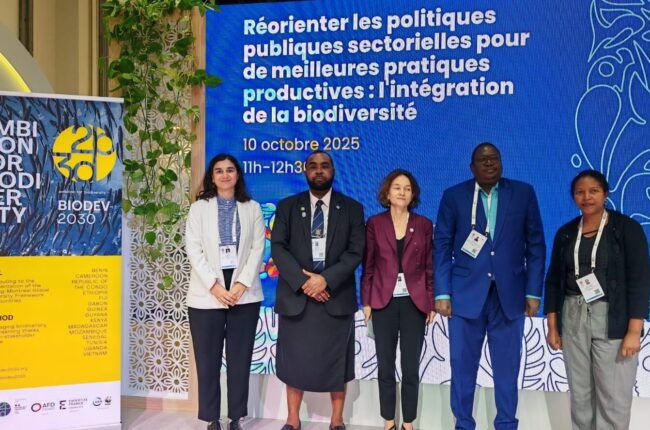
BIODEV2030 at the IUCN World Conservation Congress: an opportunity to promote project results
The World Conservation Congress, organized by the International Union for Conservation of Nature (IUCN), was held from 9 to [...].
Read more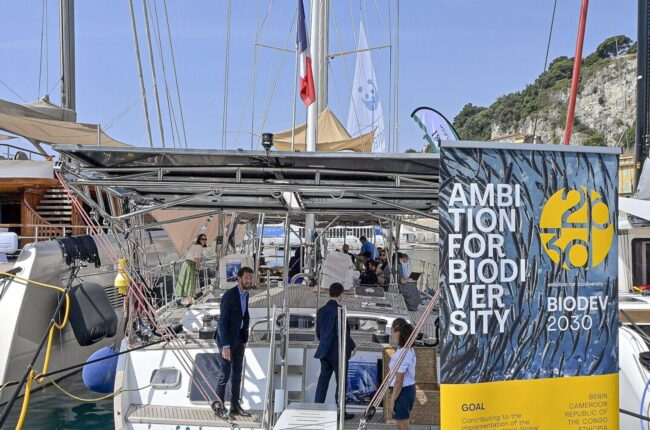
UNOC3: perspectives on better integration of marine biodiversity into public fisheries policies and production practices
France co-hosted the third United Nations Ocean Conference (UNOC-3) in Nice, France, from 9 to [...].
Read more
Identifying and discussing sectoral public policy instruments with a high impact on biodiversity
Encouraging changes in production practices at national level: BIODEV2030 supports countries in identifying the best policy instruments [...].
Read more